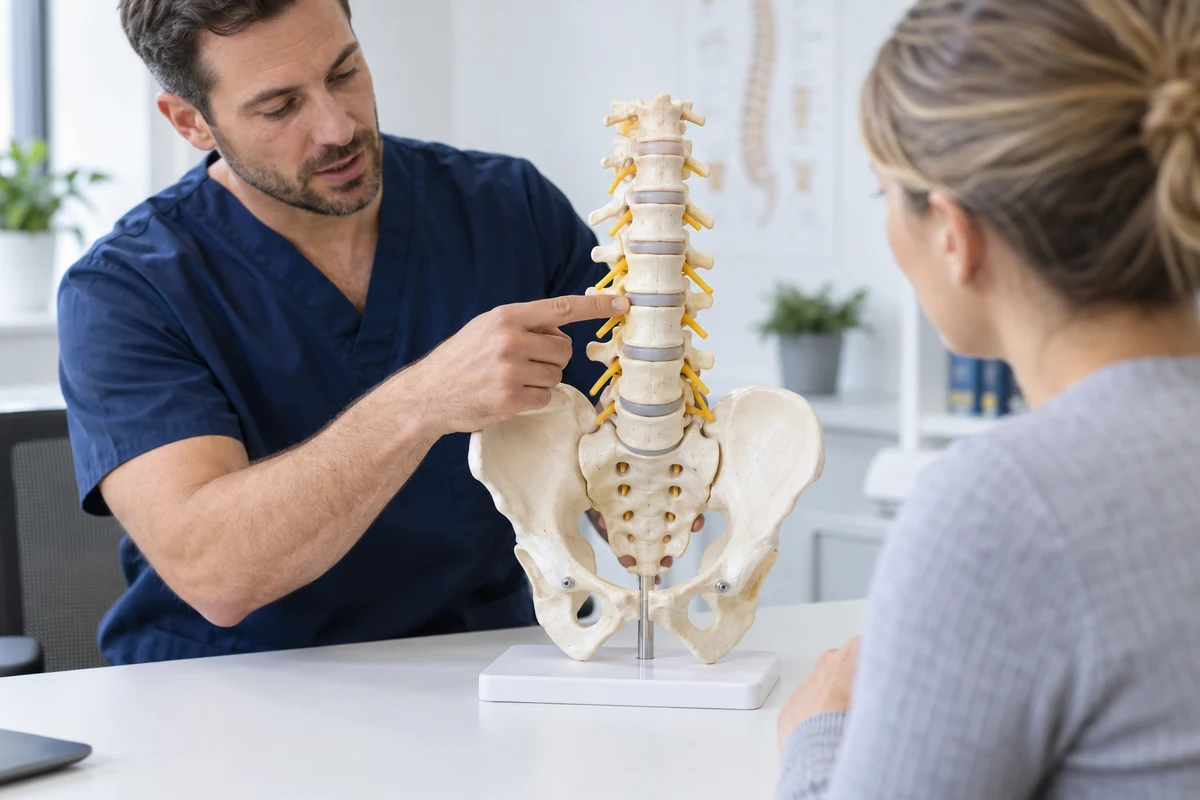
A bulging disc extends evenly beyond its normal space while the tough outer layer stays intact, while a herniated disc has a tear in that outer layer that lets the soft inner gel push out and often irritate a nerve. Both can cause back pain, neck pain, and sciatica. At Acme Chiropractic in Ankeny, Des Moines patients receive chiropractic adjustments, spinal decompression, and rehab tailored to their specific disc condition.
Understanding Spinal Disc Anatomy
Your spine has 23 intervertebral discs that sit between the vertebrae from the neck to the lower back. Each disc works like a cushion and shock absorber.
Every disc has two main parts:
- Annulus fibrosus: the tough, layered outer ring that holds the disc together
- Nucleus pulposus: the soft, gel-like center that absorbs pressure
Think of a disc like a jelly donut. The dough is the annulus fibrosus, and the jelly is the nucleus pulposus. How the donut changes shape is what separates a bulging disc from a herniated disc.
What Is a Bulging Disc?
A bulging disc happens when the disc extends outward beyond the edges of the vertebrae, usually around a broad portion of its circumference. The outer ring is stretched and weakened, but it has not torn open.
Using the jelly donut example, a bulging disc is like a donut that has been squashed so it spreads out at the sides. The jelly is still inside.
Common Causes of a Bulging Disc
- Natural aging and disc dehydration
- Degenerative disc disease
- Repetitive bending, lifting, and twisting
- Poor posture and long hours of sitting
- Extra body weight
- Genetics
Bulging discs are very common and often show up on MRI scans of people with no pain at all. They become a problem when the bulge presses on a nerve root or the spinal canal.
What Is a Herniated Disc?
A herniated disc happens when a crack or tear in the annulus fibrosus allows part of the nucleus pulposus to push through. It is also called a ruptured disc, slipped disc, or disc extrusion, depending on severity.
In the jelly donut example, a herniated disc is like a donut with a split in the dough where the jelly squeezes out.
The escaped disc material can press directly on a nerve root and can also release inflammatory chemicals that irritate the nerve. That is why herniated discs are more likely than bulging discs to cause sharp, radiating nerve pain.
Common Causes of a Herniated Disc
- Lifting something heavy with a rounded back
- Sudden twisting or a fall
- Car accidents and sports injuries
- Long-term disc degeneration that weakens the outer ring
- Repetitive strain from work or exercise
Bulging Disc vs. Herniated Disc: Key Differences
Outer Layer
A bulging disc has an outer layer that is stretched but intact. A herniated disc has a tear in the outer layer.
How Much of the Disc Is Affected
A bulging disc usually involves a broad area of the disc edge. A herniated disc usually involves a smaller, more focused area where material pushes out.
How It Develops
Bulging discs tend to develop slowly over time from wear and aging. Herniated discs can develop gradually or suddenly after an injury.
Nerve Irritation
Bulging discs may or may not touch a nerve. Herniated discs are more likely to compress and chemically irritate a nerve root.
Typical Pain Level
Bulging discs often cause mild to moderate back or neck pain. Herniated discs more often cause sharp pain that travels into the arm or leg.
A bulging disc can progress to a herniated disc if the outer ring keeps weakening. Early care can help reduce that risk.
Symptoms of Bulging and Herniated Discs
Symptoms depend on the location of the disc and whether a nerve is affected.
Lumbar Disc Symptoms (Lower Back)
- Low back pain and stiffness
- Sciatica that travels down the buttock and leg
- Numbness or tingling in the leg or foot
- Leg or foot weakness
- Pain that worsens with sitting, bending, coughing, or sneezing
Cervical Disc Symptoms (Neck)
- Neck pain and stiffness
- Pain between the shoulder blades
- Pain that travels into the shoulder, arm, or hand
- Numbness or tingling in the fingers
- Weak grip or dropping objects
When to Seek Emergency Care
Go to the emergency room for loss of bladder or bowel control, numbness in the groin or inner thighs, or sudden severe weakness in the legs or arms.
How Is a Disc Problem Diagnosed?
An accurate diagnosis starts with a detailed history and hands-on exam. At Acme Chiropractic, we evaluate:
- Your symptoms, their pattern, and what triggers them
- Posture, spinal motion, and muscle tension
- Reflexes, strength, and sensation in the arms or legs
- Orthopedic tests such as the straight leg raise or Spurling's test
An MRI is the most accurate imaging test for seeing discs. X-rays show bones and alignment but not the discs themselves. If imaging is needed, we will explain why and help you get it.
How Chiropractic Care Helps Bulging and Herniated Discs
Most bulging and herniated discs improve with conservative, non-surgical care. Chiropractic care focuses on reducing pressure on the disc, restoring healthy spinal motion, and supporting your body's natural healing.
Spinal Decompression Therapy
Non-surgical spinal decompression uses a computer-guided table to gently stretch the spine in cycles. It is designed to lower pressure inside the disc, help retract disc material, create space for irritated nerves, and improve disc hydration.
Chiropractic Adjustments
Gentle adjustments restore motion in stiff joints above and below the injured disc. This helps spread forces evenly through the spine. For disc patients, techniques are chosen carefully, and low-force options such as the Activator technique are available.
Flexion-Distraction and Mobilization
Controlled, rhythmic movements can help improve disc and joint mobility while keeping you comfortable.
Rehab Exercises and Core Strengthening
Strong deep core, glute, and back muscles reduce the load on your discs. Your plan will include exercises you can do at home.
Posture and Ergonomic Guidance
We help you adjust your workstation, driving position, sleep setup, and lifting habits to protect the healing disc.
Is Chiropractic Care Safe for a Herniated Disc?
Chiropractic care is considered safe for most people with bulging or herniated discs when it begins with a thorough exam and uses appropriate techniques. Your chiropractor will avoid any movement that increases nerve symptoms.
If your symptoms include progressive weakness, severe nerve compression, or signs of a more serious condition, we will refer you to a medical doctor or spine specialist.
How Long Does Disc Recovery Take?
Recovery depends on the type and size of the disc problem, your age, overall health, and how consistently you follow your plan. Many patients notice improvement within two to four weeks, and most disc injuries improve significantly within six to twelve weeks of conservative care.
Daily Habits That Protect Your Discs
Whether you have a bulging disc or a herniated disc, everyday habits play a major role in how quickly you recover and whether the problem returns.
- Take a short walking break every 30 to 45 minutes when you sit for work
- Keep heavy objects close to your body and lift with your legs
- Avoid bending and twisting at the same time, especially when lifting
- Use a lumbar roll in your office chair and car seat
- Sleep on your side with a pillow between your knees, or on your back with a pillow under your knees
- Stay hydrated, since spinal discs are made largely of water
- Keep up with the core and hip exercises from your care plan, even after pain improves
For Des Moines and Ankeny residents, seasonal tasks like shoveling snow, raking leaves, and spring yard work are common times for disc flare-ups. Pace yourself, take breaks, and push rather than lift whenever possible.
Frequently Asked Questions
Is a bulging disc worse than a herniated disc?
A herniated disc is usually considered more serious because the outer layer has torn and disc material is more likely to irritate a nerve. However, a large bulging disc can also cause significant symptoms.
Can a bulging disc turn into a herniated disc?
Yes. If the outer ring continues to weaken, a bulging disc can progress to a herniation. Early care and protective habits can help reduce that risk.
Can a chiropractor fix a bulging disc?
A chiropractor can help reduce pain and pressure from a bulging disc through spinal decompression, adjustments, and rehab exercises. Many patients experience meaningful relief without surgery.
Should I see a chiropractor or a doctor for a herniated disc?
Many people start with a chiropractor for conservative care. If you have severe weakness, bladder or bowel changes, or symptoms that are getting worse, see a medical doctor right away.
Where can I find a disc chiropractor near me in Ankeny or Des Moines?
Acme Chiropractic at 701 NW School Street in Ankeny treats bulging and herniated discs with chiropractic care and spinal decompression and serves patients across the Des Moines metro.
Related Articles
- Spinal Decompression for Herniated Discs: Can It Help You Avoid Surgery?
- Can Spinal Decompression Help Sciatica? What Des Moines & Ankeny Patients Should Know
- Neck Pain From Sitting at a Desk? How Chiropractic Care Can Help With Tech Neck
Get Answers About Your Disc Pain
Whether your MRI says bulging disc, herniated disc, or protrusion, the trusted team at Acme Chiropractic will explain what it means for you and build a non-surgical plan to help you move and feel better.
Call (515) 341-0120 or visit 701 NW School Street, Ankeny, IA 50023 to schedule your disc evaluation. We proudly serve Des Moines, Ankeny, Johnston, Altoona, Urbandale, and Polk County.